

A land remembered volume.., p.1
A Land Remembered, Volume 1, page 1


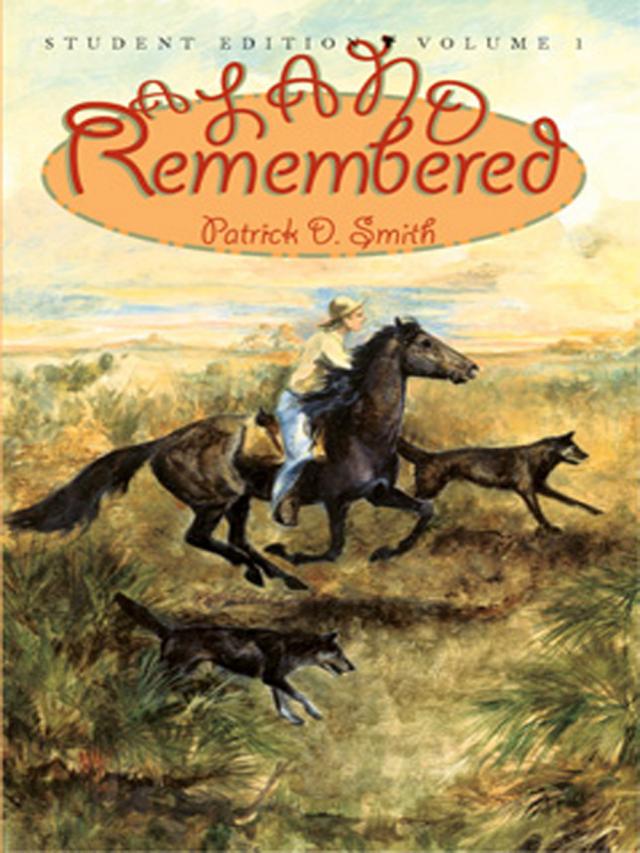
A Land Remembered
Volume One
A Land Remembered
Volume One
Student Edition
Patrick D. Smith
PINEAPPLE PRESS, INC.
Sarasota, Florida
Copyright © 2001 by Patrick D. Smith
All rights reserved. No part of this book may be reproduced in any form or by any means, electronic or mechanical, including photocopying, recording, or by any information storage and retrieval system, without permission in writing from the publisher.
Inquiries should be addressed to:
Pineapple Press, Inc.
P.O. Box 3889
Sarasota, Florida 34230
www.pineapplepress.com
LIBRARY OF CONGRESS CATALOGING IN PUBLICATION DATA
Smith, Patrick D., 1927–
.— Student ed., 1st ed.
p. cm.
Summary: Traces the story of the MacIvey family of Florida from 1858 to 1968.
Volume 1 : ISBN 1-56164-223-1 (pb : alk. paper) ISBN 1-56164-230-4 (hb : alk. paper)
Volume 2 : ISBN 1-56164-224-X (pb : alk. paper) ISBN 1-56164-231-2 (hb : alk. paper)
[1. Family life—Florida—Fiction. 2. Florida—Fiction.] I. Title.
PZ7.S65748 Lan 2001
[Fic]—dc21
00-053749
Volume 1: 978-1-56164-582-4 (e-book)
Volume 2: 978-1-56164-583-1 (e-book)
First Edition
Print design by Carol Tornatore Creative Design
Printed in the United States of America
To the grandchildren –
Dan, Kimberly, Joshua, Matthew, and Alex
with love from “Grampy”
Table of Contents
FOREWORD
CHAPTER ONE
CHAPTER TWO
CHAPTER THREE
CHAPTER FOUR
CHAPTER FIVE
CHAPTER SIX
CHAPTER SEVEN
CHAPTER EIGHT
CHAPTER NINE
CHAPTER TEN
CHAPTER ELEVEN
CHAPTER TWELVE
CHAPTER THIRTEEN
CHAPTER FOURTEEN
CHAPTER FIFTEEN
CHAPTER SIXTEEN
CHAPTER SEVENTEEN
CHAPTER EIGHTEEN
CHAPTER NINETEEN
CHAPTER TWENTY
CHAPTER TWENTY-ONE
CHAPTER TWENTY-TWO
CHAPTER TWENTY-THREE
FOREWORD
It is a great pleasure to introduce a new generation of readers to one of my favorite books, given to me years ago by my grandfather, who also loved it. It tells an authentic and exciting story set amidst Florida’s unique historical and cultural heritage. As you follow this family through several generations, you will see our state as it was then and understand better how it came to be as we know it today. The landscapes and people you will meet in A Land Remembered have changed over time. Many of you will recognize the places described here; others will be encouraged to seek them out.
The compelling tale of this family, enduring hardship, poverty, and the forces of nature, will imprint itself on each of you. You will share their tragedies and triumphs, while learning how the choices they made still impact us today. It is as enthralling a tale as it is inspiring, one that will change the way you see our state and your place in it.
A Land Remembered brings to life some fascinating cultures that are woven into the fabric of our state. Beginning with the Indian peoples who lived here for over 12,000 years, and the Spanish, French, and English settlers who followed them, Florida is a blend of many societies. The story of Tobias, Emma, Zech, and Solomon that you are about to read is just one of many exciting tales of Florida’s past. Today’s Florida is an exciting cultural mix of Caribbean, Latin American, Asian, and European traditions. Each has a colorful and exciting history that they bring to our state. Your family will have as great an impact on Florida history as the fictional MacIvey clan.
As you read and enjoy A Land Remembered, think about how the characters in this book adopted Florida and made it their real home. Each of us leaves an indelible mark on this pristine land for future generations to revere or decry. This marvelous story helped me to see our state in a new light. I hope it will help you, too, to think of Florida as your precious land, illuminate our exciting history, and inspire you to be a thoughtful steward of our environment.
You are about to enter A Land Remembered, a land which still can be experienced if you venture off the interstate. Enjoy the adventure!
Katherine Harris
Florida Secretary of State
CHAPTER ONE
La Florida
1863
“Not again!”
The sound of it boomed across the small clearing and seemed to rattle the palmetto trees just beyond. A startled rabbit jumped straight upward and then bounded off into the brush.
“They done it again!”
This second outburst caused a flight of crows to change course and shriek loudly in protest.
Tobias MacIvey kicked at the dry dirt with his worn brogan shoe. His black-bearded face showed sweat beneath the protection of a wide-brimmed felt hat, and his slim six-foot frame was dressed in a pair of badly faded overalls.
Just then Zechariah MacIvey came out of the brush, running as fast as his six-year old legs would carry him. He scurried through the split-rail fence and shouted, “What’s the matter, Pappa? What is it?”
“Them wild hogs done pushed through the fence again and got in the garden. Just look at that! Everything I planted is rooted up, and I ain’t got no more seeds. Guess we’ll have to eat acorns this winter right alongside the squirrels. From the looks of this mess them hogs ain’t been gone from here more than a half hour. Maybe we can at least get some meat out of it. Run fetch my shotgun while I fix the fence and see if I can save anything.”
“Yessir, Pappa. I’ll run fetch it and be back real soon.”
Tobias was on his knees, trying to straighten a collard plant, when the boy returned. He staggered as he half-carried and half-dragged a double barrel ten-gauge shotgun that looked to be as long as the trunk of a cabbage palm. He also had a shell sack around his neck.
Tobias took the shotgun and lifted it to his right shoulder, and then Zech followed as the thin man left the garden and followed a trail southward into thick woods. Tobias studied the tracks carefully, and then he said, “Looks to be about six or seven of them. They’re heading for the creek to wash down my vegetables. You be careful of snakes. In this heat they’ll be laying up under bushes. I wish them hogs would eat snakes like they’re supposed to and leave the garden alone.”
They moved silently past a thick stand of hickory trees; then the man motioned for the boy to stop. “You be real quiet from here on,” he cautioned. “They’re just up ahead. We don’t want to come on them sudden like and have ’em turn on us. Then you’d really learn how to shinny up a tree in a hurry.”
Once again they moved forward slowly, the shotgun now pointing to the ground. Tobias suddenly stopped and lifted the gun to his shoulder. Fifty feet ahead the seven hogs came out ofa clump of palmetto and faced him. All were boars and eachhad tusks that formed a complete circle. The hogs looked ready to charge when Tobias pulled the trigger, sending forth a tremendous boom followed by a thick cloud of smoke and fire.
For a moment neither man nor boy could see through the smoke, and the sound of animals running frantically overwhelmed the echo of the shotgun. Then the wind whisked the gray cloud away, and before them one boar ran in a close circle, the entire top of its head missing, blood spewing over the ground in a flood. Then the boar fell to the ground, kicked wildly for a moment, and lay still.
Tobias said, “You see where I shot him, Zech? Right in the head. You gut shoot a wild boar, he’ll run a hundred yards after he’s hit, and tear your leg off with them tusks. Always shoot him in the head so he can’t see you and come after you. You best take note of this.”
“Yessir, Pappa,” the boy said, his voice quivering. The sight of so much blood was making him sick. He forced himself to watch as his father slit the boar’s throat to make sure it was dead.
Tobias then ran the knife blade down the hog’s stomach, dumping the entrails onto the ground. He said, “There’s my collards, right in his belly. He won’t eat nothing of ours no more. He’s a big one, over two hundred pounds, and he’s sure too heavy for me to tote back to the house. You wait here while I go and get one of the oxen. Then we’ll drag him back.”
The boy sat down reluctantly beside the bloody carcass as the man walked away quickly.
***
Tobias MacIvey was thirty years old and had been in the Florida scrub for five years. He had come south out of Georgiain 1858. In his horse-drawn wagon there was a sack of corn and a sack of sweet potatoes, a few packets of seeds, a shotgun and a few shells, a frying pan, several pewter dishes and forks, and a cast-iron pot. There were also the tools he would need to clear the land and build a house: two chopping axes, a broadaxe foot adz, crosscut saw, auger bite, a fro and drawing knife.
His wife, Emma, five years younger t han he, held the baby as gently as possible as the wagon bounced over an old Indian trail that skirted to the east of the Okefenokee Swamp and then turned due south.
Tobias had owned forty acres of red Georgia clay which he tried to farm and failed. When he sold the cabin and land he had enough money to buy only what was in the wagon.
When they crossed into Florida and reached Fernandina, Tobias traded his horses for a pair of oxen which Zech named Tuck and Buck. Included in the trade was a guinea cow, a strange-looking little Spanish animal with a small body that stood only one foot from the ground. But she would provide milk for all of them.
The rumble of a coming civil war had already been felt in Georgia when Tobias left the clay hills and headed south to seek a new life in an unknown land. He knew it was just a matter of time. He also thought the war would not affect Florida as it would Georgia, and if he went into the eastern scrub area, he would be left alone for a long time, perhaps forever. There was nothing in the Florida wilderness worth fighting over. And his guess had been right. The war thus far touched only the coastal areas of the state, and because his homestead was so isolated, he knew little of what was happening. Occasionally a stranger would drift by and give him the news. He would also hear of the war when he made trips to a small settlement on the St. Johns River to trade animal hides for supplies.
The first two years in Florida had been a time of near starvation. He cleared a garden and planted his precious seeds, but the poor sandy soil offered little in return. And the wild animals were a constant problem when plants did break through into the sunlight. Deer, turkey, and hogs were plentiful in the woods, but shells were so hard to come by that he could kill only when he had to. Also during the first year, panthers killed the guinea cow and left only a pile of shattered bones.
During this time they lived in a lean-to made of pine limbsand palmetto thatch. There was nothing to ward off the summer mosquitoes and the roaming rattlesnakes and the rain and the biting winter cold. Emma feared for the safety of the baby, and they finally made a crude hammock so that she could at least keep him off the ground.
In the second year, Tobias started building the house, cutting the logs in a nearby hammock and dragging them to the site with the oxen, shaping the logs and lumber by hand, building a wall one torturous foot at a time. The roof was of cypress shingles, and devoting what time he could to produce them, he made twenty-five each day. It took more than five hundred to build the roof. More than a year of sweat and pain went into the rugged structure before it was complete enough for them to move inside. Yet ahead of him was the task of building beds and tables and chairs and completing the mud and stone fireplace.
There were many times when Tobias thought otherwise, but they did survive. He learned many things by trial and error, and passing strangers told him of others. He learned that he could plant a wide-grained rice in rows on sandy ridges and that it would grow without irrigation, depending solely on the natural elements. Some of the seed had been given to him by a family heading south in an oxen caravan. When the first crop came in they whisked off the stalks by hand and then beat them inside a wooden barrel, catching the grains in a cloth sack.
He also found that nothing would grow on pine ridges but many food plants would survive in hammock ground, and after the second year he moved his garden away from the house area and into a nearby hammock.
A man in the St. Johns settlement told him that twenty miles to the west there was a herd of wild cows. They were too wild for anyone to ever catch without dogs and horse, but in one grazing area they had littered the ground with manure. Tobias went there with his wagon and brought back a load of manure for the garden, and each spring he would return for another load of the life-giving fertilizer.
Gradually, he made chairs from sturdy oak and wove cane bottoms onto them, and he fashioned a table from cypress. He trapped enough raccoons to trade their furs for a coal oil lamp so they could have light at night. Brooms were made from sage straw, soap from animal fat and lye; meat was preserved by smoking, and what few vegetables they did harvest were canned or dried for the winter. Emma learned to make flour from cattail roots and they used wild honey as a substitute for sugar. What they all missed most were milk and butter, and there was no substitute for them. He vowed someday that he would own another milk cow, and this time he would protect her better.
The one thing Tobias feared most was the abundance of predators that roamed the land: bears, panthers, and wolves. Nothing was safe from them, and he dared not go into the woods without the shotgun. Darkness was when the predators roamed freely, and he kept the oxen locked inside the small barn each night, even during the hottest part of summer.
***
Tobias came into the clearing leading the ox with the hog tied behind with a rope. Zech was riding the lumbering animal, kicking his feet into its sides and whooping loudly. The ox paid no heed to the boy as it ambled to the side of the house. Emma came outside at the sound of the commotion.
She was a robust woman dressed in an ankle-length gingham dress and high-topped laced shoes patched with deer hide. Almost as tall as Tobias, she was big-boned and brawny, and her raven-black hair was tied in a bun. Before marrying Tobias she spent her youthful days in cotton fields where her father worked as a sharecropper, and she knew work from the moment she was strong enough to carry a water bucket from well to kitchen. She was the personification of strength, and it affected all those around her.
Emma looked at the hog and said, “He’s big, but he sure is scrawny. Not an ounce of fat for lard. I’ll have to boil him down good before I can do anything with him, else he’ll be tough as shoe leather. Maybe we can grind up some for sausage. Slice off a few thin strips of the loin and I’ll fry it for supper.”
Emma turned and went back inside the house as Tobias said, “Put ole Tuck back in the barn, son, and I’ll start the fire.” First, he would scald the hog in the huge black pot, then he would scrape the hide and cut the meat into sections. What they could not eat before it spoiled would be cured in the smokehouse Tobias had built beside the barn. The skin Emma would make into cracklins.
Soon the clearing was filled with smoke as a fire came to life beneath the cast-iron pot. Then the smell of seared flesh permeated the surroundings.
***
Late that afternoon, they sat down to a meal of fried pork and a pot of boiled poke Emma gathered in the woods behind the barn. There was also a loaf of flat bread made from cattail flour.
Tobias said, “Lord, thank Ye for the vittles. Amen.” Then he said, “Ain’t much to be thankful for, is it?”
“It’s food,” Emma said. “But I sure wish we could get some cornmeal. A pone of cornbread would go good with some fresh swamp cabbage.”
“What I hanker for is beef,” Tobias said, chewing hard on the tough pork. “A roast as big as a saddle blanket. Zech’s done growed up without tasting beef, and a boy like him needs beef to make him strong.”
“Hog is fine for me, Pappa,” Zech said, helping himself to another spoonful of poke greens.
“That’s because you ain’t had nothing better. If I had knowed it would be so hard here I might have stayed in Georgia. We got to get us a catch dog. If I just had a catch dog, I could round up some wild cows and start a herd. I need a horse too. A horse ain’t worth nothing in pulling a wagon through this sandy soil, but you sure can’t catch cows without a horse and a dog. And a dog would help keep the varmints away from here at night.”
They ate in silence for a moment, and then Emma said, “It will all come in time, Tobias. We’re not that bad off. We can make do till times get better for us. The Lord will look over us.”






