

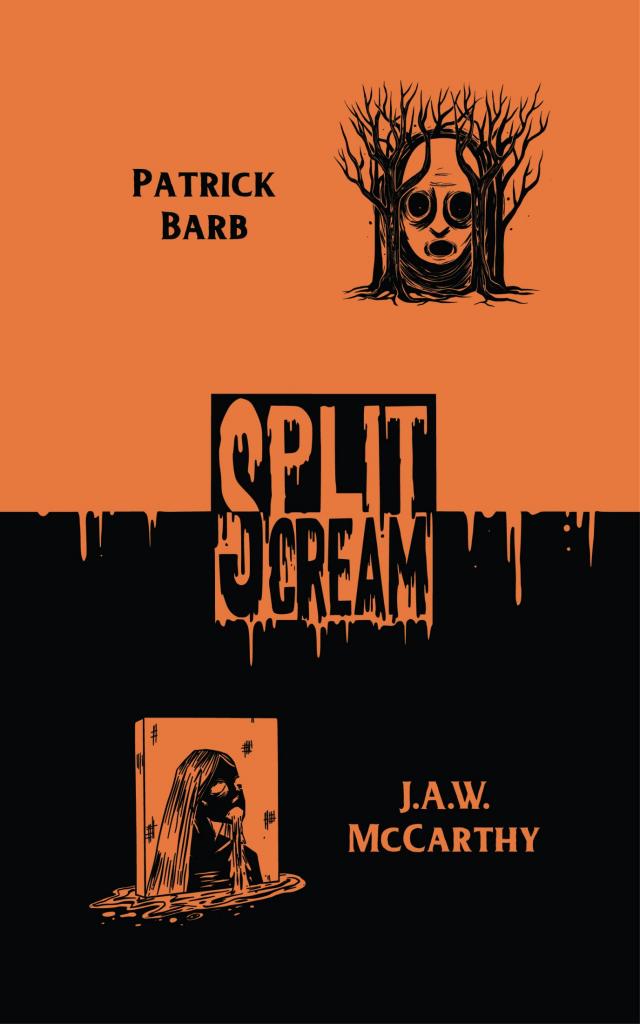
Split scream volume thre.., p.1
Split Scream Volume Three, page 1
part #3 of Split Scream Series


PRAISE FOR “SPLIT SCREAM VOLUME THREE”
“Two confrontations with the fleshy, dripping excesses of expression, the urges burbling up and out of Barb and McCarthy's characters onto the page and over the margins. Bodies as tragic exhibitions only these authors can name.”
—Andrew F. Sullivan, author of The Marigold and
The Handyman Method
“Reading the stories in the Volume Three made me think this just might be the perfect length for horror fiction. [They] are a real kick in the head, combining the urgency of the short form with the characterization, texture, and nuance of longer works. Both authors deserve recognition for the maturity and ingenuity of their writing.
Both tales are told with admirable skill, with attention to pacing and characterization as well as shock value. Although you can read the entire volume in one evening, you will end with a sense of having taken a much longer journey.”
— S.P. Miskowski, author of I Wish I Was Like You
“SPLIT SCREAM Volume Three offers up a strong publication with stories by Patrick Barb and J.A.W. McCarthy. With threads of twisted secrets and a worship of art, both tales successfully create in-depth worlds where darkness lingers. Barb’s character-driven, cosmic tale steadily builds up unique layers for readers to discover as a deeper truth is constructed, which balances nicely with McCarthy’s lush prose where layers are bled away in a beautifully poetic and visceral story. Does art heal or destroy the characters within both tales? Readers will have to pick up this delightful pairing to find out!”
—Sara Tantlinger, Bram Stoker Award-winning author of
The Devil’s Dreamland
“The third volume of the SPLIT SCREAM series features its most cohesive pairing yet. Barb’s and McCarthy’s stories reflect and refract. Both are deeply enamored with art, while exploring vastly different pathological vistas. The result is a duo that compliments each other’s aesthetics in one highly readable volume, covering both weirded-out slashers and neo-gothic tragedy.”
—Carson Winter, author of Soft Targets
PRAISE FOR “SO QUIET, SO WHITE” by PATRICK BARB
“‘So Quiet, So White’ is an edgy, suspenseful tale of paranoia, set in a remote small town where locals blame a teenager for a recent massacre. The teen’s grandfather, Roger Grimsby, is an artist known primarily for his gruesome paperback covers, and his recollections hint at secret pacts and bloody sacrifices beyond the present crisis. Barb has created such an intense, hallucinogenic atmosphere around this isolated community, the imagery and the setting will stay with you for a long time.”
—S.P. Miskowski, author of I Wish I Was Like You
PRAISE FOR “IMAGO EXPULSIO (THE RED ANIMAL OF OUR BLOOD)” by J.A.W. McCARTHY
“‘Imago Expulsio (The Red Animal of Our Blood)’ offers an impressive visceral combination of cosmic horror and body horror in a tale of two artists. The erotic becomes inextricably entwined with something terribly sinister, as we follow the protagonist’s desperate attempts to save her beloved. McCarthy’s success at devising a moving, plausible love story within this struggle demonstrates exceptional artistry.”
— S.P. Miskowski, author of I Wish I Was Like You
Volume Three
Featuring:
Patrick Barb
&
J.A.W. McCarthy
SPLIT SCREAM, Volume Three © 2023 by Patrick Barb, J.A.W. McCarthy, Alex Ebenstein, and Tenebrous Press
All rights reserved. No parts of this publication may be reproduced, distributed or transmitted in any form by any means, except for brief excerpts for the purpose of review, without the prior written consent of the owner. All inquiries should be addressed to tenebrouspress@gmail.com.
Published by Tenebrous Press.
Visit our website at www.tenebrouspress.com.
First Tenebrous Printing, November 2023.
Originally printed by Dread Stone Press, July 2023.
The characters and events portrayed in this work are fictitious. Any similarity to real persons, living or dead, is coincidental and not intended by the author.
Print ISBN: 978-1-959790-17-4
eBook ISBN: 978-1-959790-18-1
Cover illustrations by Evangeline Gallagher.
Interior illustrations by Ryan Mills.
Cover and interior design by Dreadful Designs.
Edited by Alex Ebenstein.
For the ones sticking with us.
INTRODUCTION
The novelette has been dismissed and disparaged. Some dictionaries don’t even define them as a unique form, listing only short stories, novellas, or novels. Others write them off as being “too sentimental” or “trivial”.
This is silly, of course, and, with little effort it’s easy to see the novelette has a purpose and value.
What makes a novelette, then? Exact word counts vary, but these stories are longer than a short story and shorter than a novella. In this case, between ten and twenty thousand words; or, horror you can devour in about an hour or two.
Sound like another form of storytelling?
I’m not saying a novelette is a movie is a novelette. And I’m not saying written fiction needs to be like movies. But… But they are kind of like movies in terms of length and threads, right? If you’re willing to accept that premise, at least for the moment, may I present to you…
SPLIT SCREAM
A Novelette Double Feature
Truly, what better way to present these stories than as a double feature? Do you have to read them back to back in a single Friday night after dusk? Certainly not. But could you? Absolutely.
Shall we?
Our first stop is the Grimsby House in and amongst the towering pines. It’s Patrick Barb’s “So Quiet, So White,” where a man and his grandson demonstrate the balancing act of creative arts and destructive forces. Then, in another house, a vomiting painting sits atop the mantle. But what can that painting, and J.A.W. McCarthy’s “Imago Expulsio (The Red Animal of Our Blood),” tell us about love and devotion? A vow is made, but where’s the line? Nonexistent? Let’s find out.
Okay. Are you ready? Grab some popcorn, turn the lights low, and don’t be afraid to scream.
This is a second printing for Volume Three of the SPLIT SCREAM series, now in its new home at Tenebrous Press. If you’re new to the series, welcome! If you’ve read any prior volume or iteration, my heartfelt thanks to you for coming back. In any case, I do hope you enjoy, and that you seek out more.
Long live the novelette!
Alex Ebenstein
Tenebrous Press
Michigan, USA
October 2023
Contents
SO QUIET, SO WHITE
Patrick Barb
IMAGO EXPULSIO
(The Red Animal of Our Blood)
J.A.W. McCarthy
ABOUT THE AUTHORS
ABOUT THE ARTISTS
ACKNOWLEDGMENTS
CONTENT WARNINGS
SO QUIET, SO WHITE
Patrick Barb
Twin beams of pale light pierce the darkness, illuminating the front façade of the old backwoods country house that locals call the Grimsby House. The vehicle’s headlights resemble the eyes of a nocturnal scavenger sneaking up as close as it dares to civilization so it can dig through the refuse for the tastiest morsels. The abrupt appearance of this light outside his home doesn’t wake Roger because he’s not gone to bed yet. As it stands, he’s been sleeping less and less since they released his grandson from the hospital and let the boy return to his grandfather’s care. That permission came with gruff warnings to both that they “shouldn’t leave town.” Roger Grimsby, who gave his name to the Grimsby House, isn’t one to dwell on those types of threats though. He’s well aware of his and his grandson’s rights and the words of a sheriff twenty years his junior won’t be the thing to cause him a sleepless night.
Most evenings, Roger’s upstairs in his studio working on that week’s painting commissions, keeping one or two canvases ahead of the next deadline. Lost in the brushwork for a retro creature-feature piece, adding details of radioactive crackle beneath the buzz and hum of his many work lamps. He keeps the overhead lights on as well. He’s awash in their electric glow, leaving the darkness to its own designs.
As a result of this cocooning in artificial light, it takes a moment for the extra bit of illumination outside to register for Roger.
Something pops in his back when he straightens. His doctor’s monthly matter-of-fact recitation of everything Roger does wrong in his day-to-day existence plays on a loop in his head. “You need more sleep, don’t sit like that, you need to exercise, don’t worry so much…”
Roger slides his feet into the house shoes he keeps nearby and the old wood floor creaks under his slow trudge around the room. He turns off the lamps and flips the switch for the overheads. Darkness falls with slick determination, like a damp bath towel slithering off a towel rack and unfurling across a steamed-up bathroom floor. Living on a mill road with an acre of towering pines with spindly branches exploding toward the sky on either side, separating his home from the nearest neighbor and the rest of the world, when the lights go off in Roger’s home no star shine or moonglow’s getting in.
But those twin beams remain steady in their silent assessment of the house.
It’s Clint. Gotta be. Boy snuck out, now he’s pushing the old Mustang down the drive so I won’t hear when he cranks that engine. It’s what his daddy used to do. Too bad Clint probably snuck into my stash be forehand and got himself too shitfaced pre-gaming on my Johnny Walker to notice he’d gone and turned the high beams on…
Clint’s daddy was Roger’s son though. Richie.
Richie: the lost and broken link in a chain meant to connect the old artist and the sullen teen now living under the roof of the Grimsby House. Back when Richie was the one trying to creep out or back home (depending on the hour), Roger had the bandwidth to work on his paintings—cranking them out to keep up with the demand of paperback publishers whose lurid horror titles filled the racks of the grocery marts until they didn’t—and to listen for his son’s foolhardy attempts at sneaking around in a too-loud and too-fast car.
Now, when he’s lost in his work and the quiet leaves him holding conversations in his head to pass the time, Roger’s certain he wouldn’t even notice if Clint pulled out, Mustang’s tires spinning gravel, horn honking loud enough to wake the Brandons’ coon dogs next door.
In the dark, his hands grip the window. Arms tensed, he’s prepared to push it open and give this intruder more than a little piece of his mind.
But he stops short of doing so. Instead, he steps away from the latch and stands in the shaft of light bouncing up from the slick gray stones of the gravel driveway. Gazing out the window, Roger spots his silhouette etched across the ground, a black form in the middle of a white circle. Like the Man in the Moon’s crash-landed in the front yard.
Moon and all.
Roger waits. And listens.
Listens and waits.
He’s sure the Mustang’s engine growls in the dark, like a caged lion whose lazy afternoon at the zoo’s been interrupted by someone falling over the protective barrier surrounding the beast’s enclosure. An unexpected treat to reveal the limits of the savage creature’s domestication…
No matter how far they come, it’s never far enough.
Then, Roger changes his mind about what’s rumbling, deciding it’s much closer. Now, he’s sure it’s his stomach making the racket. He believes he ate some meal that day. But he’s not certain. Things like food get away from him when he’s painting.
“Grandpa! A car’s in the driveway! I dunno whose.”
With the exclamation from the downstairs bedroom that Clint’s staked for his own and inhabited ever since the boy’s daddy went away, Roger’s breath hitches. It’s like he’s taken a bad swallow of rotten moonshine reality. The truth goes down the wrong tube and it burns.
“Shit.”
Downstairs, Clint’s plodding teenage feet stomp toward the front of the house, echoing with each step so it sounds like he’s an army of one. “Gonna check who it is out…” The boy’s grumbling speech lapses into incoherent muttering.
Probably believing he’s still asleep and this is all some strange dream, right?
Roger doesn’t fault him for that mistaken perception. After all, it’s been a while since any visitors pulled up their winding driveway.
Only one bar way out this way, the Miller’s Daughter. Is that ol’ juke-joint even still open?
When Richie was a kid, the family would get drunks pulling off the mill road and onto their driveway, slow-rolling the vehicles close enough to the Grimsby House—but never too close. They’d sleep off their drunk and be gone by morning. Harmless.
Hell, it was a sure sight better for public safety than having ‘em driving drunk and too fast on these old country roads out here.
But another voice, striving to make itself heard from the back of Roger’s head, suggests there’s something more at play. It’s a familiar voice, but one he hasn’t heard from in years. Suddenly, it finds its tone and tenor once again, before proceeding to tell the old man that the person behind the wheel carries ill intentions directed at the old house’s two inhabitants.
Roger doesn’t have his number listed and he keeps his address out of the phone book white pages as well. Since he uses a P.O. box for his art business, he doesn’t find much reason for folks to know where precisely he hangs his hat.
Still, they live in a small town. Small enough for someone to procure that information quite easily if it’s what they desire. God knows the reporters had dug the details up fast enough after the news about the dead bodies at Clint’s summer camp broke onto the national wires. Cars and vans parked in crooked lines on either side of the old mill road, all their tires sinking into the churned-up muddy roadside. Heavy cameras hefted on wide shoulders swept across the pines until they found a gap in the foliage, then they waited for Roger’s truck to emerge from the driveway and turn onto the road. Those savvy camera operators snapped photo after photo in a blur of hot, white light. He couldn’t see their faces then, but he could well imagine what they looked like. Eager, desperate, hungry.
Now, Roger can’t help but wonder: did all those cars and trucks and vans belong to professionals, folks out doing a job and looking for a good story? Or a good angle on a bad story? Behind the flashes, the ebony camera shutters’ blinking, was someone else blending in with the crowd and watching us? Waiting?
Staring into the night, those thoughts thrive like mushrooms. They soon fill every available space in his head with a meaty-sweet sickness.
“Don’t…” Roger’s warning starts well enough, but falls apart when he begins to move. As his legs start to get away from him, he wobbles at the top of the stairs, gripping the wooden banister so hard he’ll be picking splinters out of his palm until sunrise. By the time he’s recovered and finished his warning, it comes out as a weak, watery croak. “…open that door. Don’t!”
Light shines through the front of the house into the first floor, so when Clint turns to face his grandfather the backlighting hides his face in shadows. As though all the darkness outside has concentrated in the foyer and then got itself dressed up in the teenager’s hand-me-down Lynyrd Skynyrd t-shirt and boxer shorts—the raggedy pair with hearts on them.
“Grandpa?”
“Go back to bed,” Roger says, finding his voice once more.
“But…”
“Whoever it is, they’ll leave soon enough. If they wanted something, they’d let us know.”
The boy grumbles, but it’s less from frustration at his grandpa and more from being disturbed from whatever pursuits teenage boys get up to in their rooms when they’d probably be better off just sleeping. In the end, he listens though. By the time Roger’s made it down the stairs, he’s the only one still up and about in the house.
And that’s just fine as far as he’s concerned.
Time passes.
When the sun finally comes through the front windows, dark circles ring Roger’s bloodshot eyes. His back and knees ache even more from sitting up all night, staring at the high beams until they departed, taking the car and the driver with them. He’d spent the rest of his time staring into the void of the night remaining. In case they come back. Black spots encased in corpse-pale white explode behind his eyes until he adds a couple fingers of bourbon to his Folger’s—all of the black liquid poured into an old spiderweb-cracked mug declaring Roger to be the “World’s Greatest Grandpa.”
The downstairs telephone rings. Roger answers, but waits for the person on the other end of the line to speak first.
“Mr. Grimsby?”
“Uh-huh.”
“This is Detective Norris. I’m here with Detective Charles.”
“Uh-huh.”
“Well, sir, we’re wondering if you maybe got our last message on your machine. Called ya again about coming down to the station and talking to us?”
“Mmm.”
“It sounded like your machine might’ve got filled up there and cut off the last bit of what we said. So, we wanted to try you at home one more time and nail down a date for…”






