

Cord 5, p.1
Cord 5, page 1


The Home of Great Western Fiction!
LIFE AND DEATH DEAL
Cord and Chi hanker to settle down after a life on the run. But jail, not a hideout ranch, is in theirhand of cards.
Seems the Governor of Idaho Territory is out to nail Chris Kelly, desperado and Cord’s old compadre. He wants Cord’s help—and he’s holding Chi hostage to get it.
When the stakes are high, Cord gets ruthless …
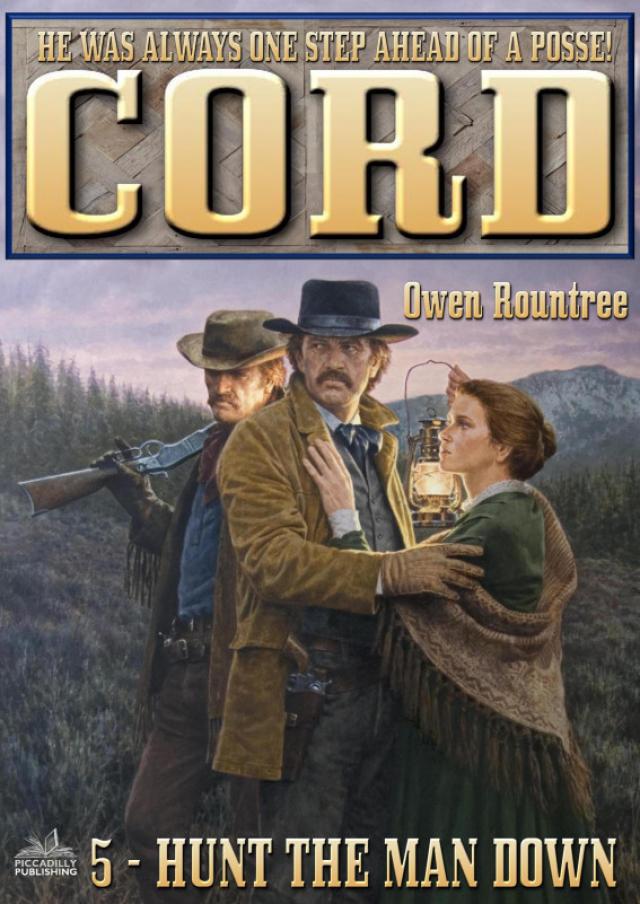
CORD 5: HUNT THE MAN DOWN
By Owen Rountree
First Published by Ballantine Books in 1984
First Digital Edition: September 2019
Copyright © 1984, 2019 by William Kittredge and Steven M. Krauzer
Names, characters and incidents in this book are fictional, and any resemblance to actual events, locales, organizations, or persons living or dead is purely coincidental. All rights reserved. No part of this book may be reproduced or transmitted in any form or by any means, electronic or mechanical, including photocopying, recording or by any information or storage and retrieval system, without the written permission of the author, except where permitted by law.
This is a Piccadilly Publishing Book
Cover Painting by Gordon Crabb
Series Editor: Ben Bridges
Text © Piccadilly Publishing
Published by Arrangement with the authors.
One
Chi always said she could tell a good hotel from across the street. Good hotels had curtains in the upstairs windows and were not located over saloons. Good hotels had signs done with stencils instead of freehand, and town ladies did not cross the street to avoid passing in front of them. What good hotels did not have was some hombre sitting out front in a captain’s chair with a rifle across his knees, looking at ease and ready to kill.
So the Rancher’s Rest in Twin Falls should have been all right. There were clean lace-edged drapes blowing from the open windows above the veranda. And the collie dog on the plank boardwalk opened one eye and seemed satisfied and went back to sleeping as they tied their horses to the hitching rail. On the way to the center of town they had passed rows of Lombardy poplar in green spring leaf along the irrigation ditches, and white lilac blooming by the dooryards of the homes on the shaded side streets, and clean, sweet-smelling laundry on lines flapping gently in the breeze. The occasional passersby looked occupied with their own legitimate business, and generally well fed, and the main brick-cobbled street was mostly swept clean of horseshit.
The only trouble was that this was Idaho Territory, and Cord had known all along they should never have crossed its border, no matter how many miles it saved in their travels, the uneasy feeling like a back itch just out of fingertip reach.
But Cord had turned from instinct and Chi’s misgivings and years of outlaw experience, and led them into this town anyway. He told himself that something like fate had taken charge over reason, and in fact he felt that he and Chi had been wandering dumb and preoccupied through the last few months. He did not seek trouble, and so he convinced himself it would not seek him, tunneling his vision straight down trail and denying the past.
Sure as hell would never freeze, he should have kept them clear of Idaho, and this fine safe hotel with its blowing curtains and free, engraved letterhead stationery and gilt-leaf Bible, but even now Cord could not get his mind off the notion of an afternoon nap and then some drinks along with the sunset.
Even now that the trap was sprung, and the small room was filled with guns pointing their way.
Goddamn it, Cord thought almost petulantly, this isn’t right. They had been suckered, come riding into this modern town of Twin Falls and up to the Rancher’s Rest, had paid for two rooms with silver money and settled in like sensible weary travelers. They had taken lunch, and later Chi came down to his room to share a smoke and make medicine with the one called Jaeger. Cord had kicked out of his boots like a man at perfect ease.
And now this shit.
Jaeger sat in a straight-back wooden chair by the curtained window. He was a stocky man, and he wore a freshly brushed derby hat and a dark brown gabardine suit, a stiff collar, and a striped tie. He reached inside his coat and took out a little .45 with a two-inch barrel, the one Colt called the Shopkeeper’s Model in the lithographed advertisements. Jaeger showed them the gun and his wide-toothed smile.
Jaeger, the prevaricating, gap-toothed son of a bitch.
Chi sat on the bed, back against the wall, knees drawn up, and hands hidden under her woolen serape, only the bottom half of her high, hand-tooled black leather boots visible. Cord stood between the door and window in stocking feet, feeling planless as a dog stopped in the middle of the street.
A moment before, the place had erupted with men with guns. Two came out of the closet at the same time two more came through the door. These four were holding down on Cord and Chi with revolvers while Jaeger played with his little Colt and a sixth man kept an eye on things from the balcony, sweeping the room through the open window with a Winchester carbine, leaning forward so the curtains wouldn’t whip across his face.
Unlike Jaeger’s citified duds, these men wore trail clothes, though to Cord’s eye they had neither the quiet confidence of lawmen nor the hard-edge cold-bloodedness of true gun handlers off the bandit routes. Their bravado was diluted by the reek of their nervous tension.
Cord raised his hands shoulder high and after that no one moved. The derby-hatted man looked up at Cord, grinning like a spook, and said, “You remember me. Jaeger is the name.” This was a little extra smartass bullshit on his part; they’d met him an hour or so earlier.
Chi was looking at Cord too, and he thought he saw an accusation: Idaho, her glare said. This would not have happened in another place. But then she gazed around the room and found a better target. “Later on, Mr. Whoever-You-Are,” she said to Jaeger, “when we are beyond this trouble, there will come a time to settle scores. You will be the first. We will come looking for you right off, cabron.”
“There won’t be no later on,” the stocky man said, going on with his grinning while the other men looked as if they wished he’d get on with business. “No later on like that, anyway.” Jaeger spun the cylinder on his little Colt and listened to it clack. “You don’t want to fool with me, lady. I’m a U.S. Federal Marshal, and it’s more trouble than it’s ever worth, killing a Federal Marshal. Don’t have to tell you that, lady.”
A red-faced man near the door said, “Let’s get moving.”
Jaeger glanced at him and pursed his lips. “Right at this moment,” he said to Chi, “I am on detached duty on assignment of William Deane Majors, Governor of this Idaho Territory.”
“I know what you are,” Chi said darkly.
Jaeger watched her for a moment. “I am the Governor’s bodyguard and personal detective, and you know what that means. The Governor runs things in this neck of the woods. There’s paper on you hereabouts, lady. If the Governor wants, he can have you gut-shot and dragged naked through the streets. Or I could kill you right now, and sell your hides like you was buffalo.”
“But you’re not going to,” Cord guessed.
“Not just yet. It’s probably a mistake.” Jaeger rose from his chair. “Put on your boots, Mr. Cord. You have some traveling ahead.”
Cord felt like a damned fool while he hitched up his gray white cotton stockings, which could have stood some washing, and got himself into his boots. He was sweating a little when it was done, and for damned sure no longer preoccupied with naps and evening drinking.
“You could use some foot powder,” Jaeger said and made a show of pinching his nose. He turned away from Cord’s anger to the red-faced man. “They are all yours, Mr. Steens. Don’t lose them along the way.”
Jaeger tipped his hat to Chi as he went toward the door, and nodded to Cord. “Good to see you folk,” he said. “People like you are money in the bank.” He closed the door softly behind him.
The stink of apprehension in the room thickened in Jaeger’s absence. Steens, the leader of this sorry crew, had a lopsided, liver-sprung gut, and the pock-thickened nose in the middle of his florid face betrayed an ongoing hard romance with whiskey and tavern-life indolence. He looked around vacantly for a moment, as if he had lost track of his next move.
“You, lady,” he said finally. “Get your hands out in the open.”
Chi looked at him and did not move.
Another man sidled up behind Cord and eased the Peacemaker off Cord’s right hip. Jaeger had left it there through their confrontation, as if he took some small thrill in playing with the unpredictable. Cord lowered his arms halfway and no one objected. They were all watching Chi anyway.
“Come on, lady.” Steens’ voice was a nasal whine. “Don’t screw around.”
Cord knew Chi would not risk gunplay in this small room. Two or three shots and the air would be opaque with black powder smoke, and no doubt these edgy men would go on firing blind. Too much flying lead and no room to dodge, so people would be hit, probably them included.
But Cord still tensed and readied to move with the action. Chi would push hard as she could anyway, because stupid nervous men with guns galled her no end. Trouble was, stupid nervous men tended to react in irrational and irrevocable ways.
Chi’s right hand eased out from under her serape. She held her Peacemaker flat on her palm like a gift, not threatening anybody, smiling at these men like they were fools. She extended her arm to one of the men, and he gulped like a schoolboy and reached for the gun. Chi tipped her palm, and the gun dropped to the floor, clunking hollowly.
Th e man, another gray-faced barroom drifter from the looks of him, bent down for the Colt, and Chi kicked him in the face. Her leg up shot out fast as a bullwhip and the instep of her boot smashed into the man’s nose, snapping his head back. Bone cracked and droplets of blood arced through the air. The man howled and fell sideways, dropping his own weapon and clutching at his face. More blood seeped between his fingers as he curled into himself on the floor, gurgling like he was drowning, legs twitching and his body quivering.
Someone laughed.
But after that they were all quiet and no one moved, because it was a way to kill. A kick like that could send nose-bone stabbing deep into a man’s brain. So they watched for a silent moment to see if he was dead, but then he cursed and struggled to his knees. There was a long general sigh—of relief or disappointment, Cord couldn’t tell which.
Steens shook his head like a man come up from underwater and snapped, “Lady!”
Chi smiled up at him almost sweetly. Steens leveled his gun on her face and took a menacing step, and Cord moved instinctively to intercept him.
A gun barrel slammed down across Cord’s temple and he was not surprised, since he was seeing all this a moment before it took place, like some half-remembered dream. He missed the floor with his foot and fell with his hands still at his shoulders. Darkness condensed around a pinpoint of vision and swallowed him headfirst.
Two
First was the flashing pain, synchronized to the wagon’s progress: the quick sparks of hurt coincident with the creaks and moans of the hard-sprung buckboard as it banged along through the ruts. First there was only the ache, familiar as an old but well-remembered enemy, and then Cord heard the squeaking of harness and the clomp of hooves on hardpan dirt, and nothing else while he tried to come back to himself.
He was bound up like an animal. Leather thongs cut into his wrist and pulled his arms behind his back, and his shoulder joints throbbed. His feet were tethered to the wagon box, and someone’s dirty neckerchief was knotted across his mouth. Cord explored his confinement carefully with his eyes still closed, recalling what had happened, what had brought him to this fix.
He opened his eyes to darkness. He twisted around and saw down the tunnel of the hoop-supported canvas tarp over the wagon bed a landscape of sagebrush hills and rimrocks shadowed by the bright moon. Three of the men from the hotel room were following close behind on horseback, talking once in a while in voices that did not reach inside the wagon. A lucifer flared and someone lighted a cigarette, and Cord envied the man his freedom.
Cord used his elbows to pry himself over on his side, feeling out the limit of possibilities. The effort brought renewed flashes of pain in the back of his eyes.
Chi was there beside him, tied and gagged and awake. Her dark eyes were luminous in the reflected light and stared at him without expression, but he knew her; he knew how she felt. At times like this he could usually force himself to find the patience to wait it out, or could at least accept the futility of struggle for the moment. She could not. She hated to give up her freedom, especially at the hands of cowardly bullies like Steens and his gang of trash. She would not tolerate this, and would seethe with her anger and unleash it to take its own head if given the slightest opportunity.
Cord gave her a look that said, “Are you all right?” Chi nodded and turned away. Was some of her anger reserved for him and his foolhardy insistence on riding them into this bad business?
But there was nothing he could do about that either, not right now, except to lie easy and send the pain far away. Breathe deep and catalog the relaxation of each muscle, one by one, until they were all gone slack and the flashing was stopped, or dimmed anyway. They’d need to get well quickly as they could.
This was serious as trouble got, and they had gone down before it like children.
But that was just more history. Cord worked on his pain, concentrating on the rhythm of Chi’s breathing to control his own. At least he was coming to himself, for the first time since winter. Maybe pain was the currency of liberation.
Cord delighted in the coming of spring, and had since earliest childhood memories. On the East Texas farm where his father and mother had made their failed lives, there came a time—sometimes nearly a month, other years less than two weeks—when the land turned green and in came spring. It had been springtime when Cord left the farm for good, springtime of his sixteenth year, but not until after the green time when the hot cloudless skies reclaimed the brief moisture and the land went brown once more.
But this year Cord’s pleasure had come hard. Every cup of coffee tasted sour, and every new thing looked born to die.
They spent Christmas in Juarez across the Rio from El Paso and West Texas, and for a few weeks he and Chi had been at ease and drifting closer, taking risks with their relationship they had never dared before. Cord knew it was dangerous, but he would not draw back. Who knew where it could have led... ?
He didn’t get a chance to find out, not then, because of an old debt owed to a broken-down west Kansas prairie wasteland sheriff named John P. Kinsolving. By the time they rode out from that snow-bound carnival of death, things had changed.
There had been a girl named Aggie there, damaged and helpless and orphaned by those who were whole, and Chi had taken her in. Chi had come to the verge of admitting feelings of maternity—or anyway sorority—impossible yearnings within the framework of the life Chi had chosen. But as with her feelings for Cord, they were denied before she had a chance to accept or reject them. The girl Aggie died, and so did something in Chi: She had seen the special value of her woman’s impulses, so long suppressed as unsuitable to her outlaw ways, and mourned herself as well as the girl.
Cord understood: He had suffered black melancholia a time or two, and Chi had helped him resurface. So he tried to show her the same casual solicitude, to give her the same easy space, even while wondering where all this was carrying them.
Back there in Juarez, Cord had found himself toying with an extraordinary notion—settling down with Chi. That spring the idea returned, stronger than he’d ever allowed; maybe it would move her from her sadness. Anyway, he told himself, working on courage and ways of saying it, there was nothing more ruinous than running too long outside the law. Banditry was no trade for old men—or old women. Hell, maybe he was coming tight to the end of his own string; maybe they both were. Here was something he could abide: Chi, and a hideout rancher life with her.
All through the breaking of spring such thoughts had invaded his mind, and still he did not voice them. Not just yet, he thought. There was business to see to first.
The break came in Denver, and after that Chi began to get better.
They had drifted north with the mild weather, settling in at the Brown Palace, figuring to stay a week or so, sampling civilized living, until Cord lost patience with the city. He always did in a place where it was half a day of trouble to ride out and gallop your horse for an hour to blow the stink of so many people from your nostrils and your mind. On the second day Cord sat in the hotel’s smoking lounge, dressed in clean brushed clothes and smoking a cigar and feeling vaguely foolish. Around him were bankers and lawyers and capitalists in suits and vests and collars and low shoes, shooting Cord sidelong glances. Cord grinned at them and thought, At least I do my thieving in the open.
On the side table was a copy of that day’s Rocky Mountain News. A section entitled “Correspondence from the Territories” on an inside page caught his attention, but even so he almost missed the three-line item nestled in the middle of one of the dense columns of type. It reported, without comment, that the Montana territorial warrant on Cord and Chi, charging them with the robbery of the Equitable Bank in New Willard, west of the divide on the Clark’s Fork of the Columbia, had been dissolved, the statute of limitations having run its course.
There was good news. A Federal warrant on them—for a robbery they had nothing to do with—had been quashed six months earlier, and now this. The only trouble still hanging over their heads from the past was an old Pocatello bank job.






