

Cord 2, p.1
Cord 2, page 1


The Home of Great Western Fiction!
CORD AND CHI WON’T STAND FOR RANCHERS THROWING HOMESTEADERS OFF THEIR LAND
Freewheeling outlaw Cord and his female partner Chi pull into a small Nevada town to help Cord’s brother set up his ranch. But they don’t expect to find themselves involved in an all-out war between ruthless ranchers, who want to keep all the profits to themselves, and struggling homesteaders looking only to survive. And when Cord sees the big guys gaining on the little guys, he and Chi step in—and make all the difference in the outcome...
CORD 2: THE NEVADA WAR
By Owen Rountree
First Published by Ballantine Books in 1982
Copyright © 1982, 2018 by William Kittredge and Steven M. Krauzer
First Edition: November 2018
Names, characters and incidents in this book are fictional, and any resemblance to actual events, locales, organizations, or persons living or dead is purely coincidental. All rights reserved. No part of this book may be reproduced or transmitted in any form or by any means, electronic or mechanical, including photocopying, recording or by any information or storage and retrieval system, without the written permission of the author, except where permitted by law.
This is a Piccadilly Publishing Book
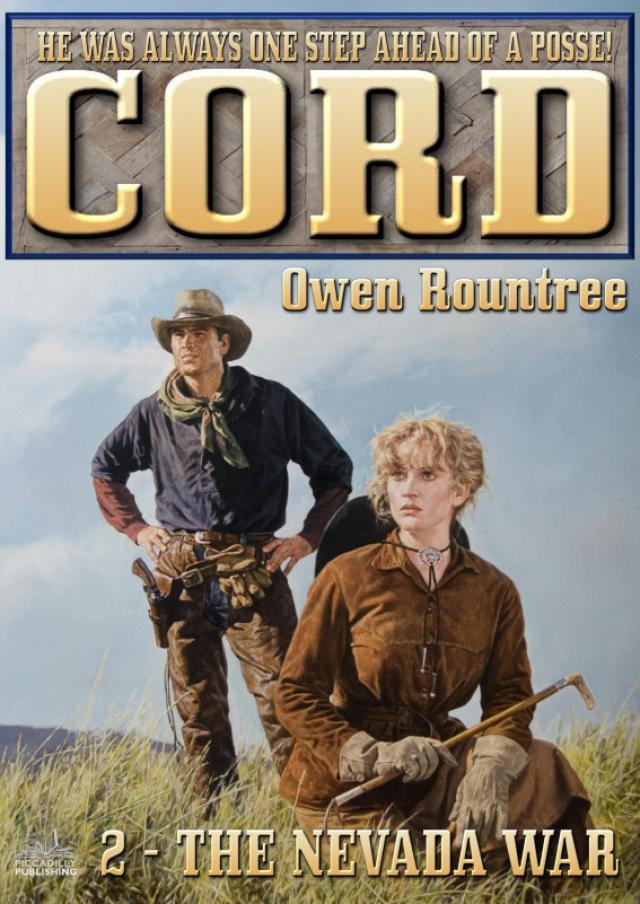
Cover Painting by Gordon Crabb
Series Editor: Ben Bridges
Text © Piccadilly Publishing
Published by Arrangement with the authors.
For Dorothy M. Johnson
With the greatest respect and admiration
Chapter One
Snakes, it had to be snakes. Cord studied the roan and white splatter-colored heifer who had bolted from the herd and now stood poised amid the field of lava-rock boulders across the draw. Sometimes when cattle got themselves into the heart of a den of sunning rattlesnakes they held like that, still and wary, all the daylight hours. They would wait until night when the snakes had quieted into the coolness, and then slip away.
It was an old thing, remembered from long in his past, and Cord was pleased. These days of work, driving his brother’s cattle, were not turning out to be so far from his life as he had imagined.
But it was not snakes after all. The heifer broke and trotted away over the ridgeline. Just more of the endless whimsical perversity of cattle. Cord spurred his big getaway bay gelding after her, down through the gulley wash at the bottom of the draw. The horse had never put in much time or been trained at working with cattle, but he had the endurance and speed and strength, and he worked up on the heifer easy enough once he knew what Cord wanted. And then—just when the heifer was turned and headed back over the ridge toward the herd—Cord heard the first reverberating rifle shot.
Cord reined up. His gelding snorted and picked up his ears. The second shot was perceptibly louder, closer, a crack coming sharp and clear in the cool springtime air. Cord spurred past the heifer and toward the top of the ridge.
From there he could see their herd spread below, 123 head of longhorn cattle threading their way through the heavy brush of the draw, easing down toward the bottomland running maybe a quarter of mile out from the South Fork of the Owyhee River to the sagebrush sandhills on either side, with endless Nevada rangeland beyond.
The dark woman, Chi, rode the near point, her sombrero set forward against the low sun, her serape wrapped around her. Chi had been his traveling partner for years now. Cord followed her gaze to the far ridge in time to see a man come riding wildly toward them on a gray horse.
The rider was firing a Winchester repeating rifle with one hand, flipping the weapon forward with each shot so its weight worked the lever to pump another cartridge into the firing chamber, and he was hurrahing at the top of his lungs. Five head of range cattle were charging along before him, hazed into a dead run and onto a straight path down into and behind the big bronco-faced Texas steer leading the herd.
The steer hesitated a moment, swinging its great horned head, then let out a bellow of fear and surprise and confusion, and broke into a trot. A young dry cow began to gallop as the range cattle came up with them, and then the leader broke and was off at a hard run, the herd spooking and following as the oncoming rider went on shouting and firing his Winchester. By the time Cord was halfway down the slope, they were stampeded into full flight, their hooves drumming the dusty alkaline ground.
“Head ’em,” Cord shouted, the sound of his voice swallowed by the distance and the bawling of the cattle. But Chi was already after them, riding low over the neck of her mare, her dark braids streaming out behind her.
The man coming over the ridge did not pull up until Cord came out of the dust, and then he scabbarded the empty Winchester and wheeled his gray horse and headed away. When Cord topped the ridge the man was a hundred clear yards in the lead.
The rider pulled his revolver and threw a wild shot over his shoulder, but Cord bore on, not overly concerned. He had been chased enough times himself to know that firing over your shoulder from a galloping horse was a waste of lead. Then the rider’s horse stumbled and the handgun slipped from his fingers as he grabbed at the saddlehorn. The pistol went cartwheeling away through the short brush.
Cord gained ground quickly. His big bay had been picked for speed. There were moments in Cord’s work when a fast horse could be the difference between freedom and a life in the jailhouse. Years before Cord had paid a thousand dollars for the horse, but it was money well spent if you had chosen a life in which there was no place for time behind other men’s bars.
The other horse, the gray, was a heavy-boned mare, fine for work around the fields and in close to the pastures along the river, but no match for the bay. Cord had already closed to shouting distance.
“Pull up,” Cord ordered.
Instead the man jerked the Winchester from the boot again and began fumbling with cartridges out of his shirt pocket.
Cord swore to himself. It was not his way to shoot a man in the back, but this fellow seemed determined on trouble.
The man risked a glance back, and Cord saw his face was white and drawn. His knees were locked around the heavy body of the laboring gray mare and he was trying to jam shells into the magazine of the Winchester.
He was still trying when Cord drew up alongside.
“Rein up now,” Cord shouted.
The man wheeled the barrel of his rifle at Cord’s head.
Cord caught it in one hand, drawing his bay gelding hard to a sliding stop. Still the man did not let go.
His mare whinnied in terror and galloped out from under him. Cord wrenched at the rifle and it came away from the man as he struck the ground. Cord flung the rifle off into the brush.
The man shook his head, dazed, and then got slowly to his feet, as if he was surprised all his parts were working. He was a big man, with a ruddy face and red hair streaked with gray. His callused hands belonged to a working man, not to a gunfighter or road agent.
Cord dismounted and unholstered his Colt .45 Peacemaker, pulling the hammer to full cock as he did, the click loud in the still air. Cord realized he could no longer hear the rumble of the stampeding longhorns.
“Explain yourself,” Cord said.
“Go to hell.”
Cord stepped forward and held the muzzle of the Colt against the man’s forehead.
“I’ve got cattle to run down, and no time to palaver,” Cord said evenly. “Who are you?”
“My name is Jack Hardy. You’ve heard of me, I reckon, if you’re hooked up with McQuire.”
There was no point in trying to make sense of that. “What have you got against me and my people back there, Jack Hardy?”
“I made a blood oath,” Hardy said bitterly and quietly, “to drive you and all the rest of your bunch out of this valley. And that black devil McQuire as well.”
“You ranch here?” Cord was guessing.
Hardy looked Cord up and down. Some of his fear and anger was seeping away, and now he was frowning, as though something wasn’t just as he had reckoned and he was trying to figure out where things had gone wrong. “Yeah,” he said slowly. “I got a spread a couple miles up the river.”
“I’ll be calling on you,” Cord said. “Depend on that.” He let the hammer down on the Colt and holstered it. The bay gelding lifted its head from where it had been picking at fresh spring grass down amid the brush, and stood waiting, expectant.
Cord swung himself into the saddle, watching the other man all the while.
“Hold up,” the man said.
Cord watched from the gelding while the other man came toward him, limping and wincing with pain.
“Listen,” Hardy said. “I might have had the wrong notion.”
“Yeah,” Cord said. “You might have at that.”
Chapter Two
These days of working with cattle had got Cord to thinking back fifteen years and a thousand miles. Remembering those days, riding out of Texas along the cattle trails north to the Kansas trail-heads, a different one every year—first Kansas City and then Junction, Abilene, Newton, and Hays City, and toward the end of those times, Dodge—when Cord had last trailed cows.
It had been an escape in the beginning, the only way out from the hardscrabble East Texas farm life he had known all the first sixteen years of his life.
Cord had been fourteen, his schooling fresh over, when the notion first took him, the realization that the overwhelming day-after-day poverty and grimness of the life he had been born to was not something he could bring himself to endure forever. One afternoon in late fall he had come into the dirt-floor room where his mother cooked and served their meals and found his parents sitting at the rough wood table, his father’s thick right hand held in both his mother’s. His mother was crying and his father’s face was gray and stiff as wood. They both looked away, and Cord backed out of the room. It took him days, but finally he came to see their life of resignation into weariness was all that waited for him if he stayed.
He would have left then, but he did not have a horse or money to buy one, and although his relationship with his father was one of careful distance, Cord would not steal from him. Instead he went to his father, and asked how long he would have to work to earn a horse and tack. His father looked at him a long time before answering. Cord remembered the deep creases fanning out from his eyes, the hard-set mouth that never had much cause for smiling.
“Two years,” his father said, in a tone that left no space for argument. After that, both of them knowing he was going to be leaving, they did not speak to each other more than came necessary in the work, the long days on the cotton rows, the plowing.
Cord’s brother Jim was five years younger, but during those two years he began to grow into a man. The brothers became closer as their parents drew more deeply into the weariness which had worn so hard into their lives. Jim knew Cord was leaving, and they talked about it until the talk grew into grand adolescent fantasy about a life away from the dry and featureless East Texas scrub farming country—a life to be, filled with romance beyond limit.
But in the end Jim stayed to work beside his father, and over the years Cord had wondered how it had been for Jim, seeing it in a hundred different ways. What had Jim felt when he found their father face down in the middle of a blowing dusty field, his chest silent and still? Did he feel more the sorrow and loss, or the elation of being free at last?
Their mother had no heart for staying, so Jim managed the sale of the place for a little more than half what their father had paid those years before. Their mother went to live with a widowed sister who owned a boarding house in San Antonio, and Jim hired on as a hand at a ranch in Jim Hogg County in south Texas, a place owned by an Englishman who visited once each winter.
Cord did not hear of any of this until years after he learned of his father’s death. At the time there had been no going back, no place for remnants of the family in the life he had built for himself.
The horse Cord’s father gave him was a swayback sorrel gelding close to twenty years old, with more experience hitched to a plow than under a rider. But then, with the old horse saddled, about to put East Texas to his back for good, Cord had been surprised by his father. The old man came out of the slant-roofed house with a bundle and handed it up to Cord, and Cord unwrapped the oilskin to find a Colt Navy .36, the old cap-and-ball pistol clean, oiled, and loaded.
“You’ll need this,” his father said, and years later Cord found himself wondering what days his father had known before settling for that silent farmer life, and what life he contemplated Cord making for himself.
Cord used the pistol the next day, soon as he crossed out of his home country. He stepped out from behind a boulder and took the center of the road and showed the gun to a man who was riding toward him, telling the man to hold steady.
The man was wearing a cutaway coat, a beaver hat, and a ruffled shirt with lace cuffs. Cord picked him because he looked like he could afford another horse. Two other riders had passed, one dressed in the dirty faded serge of a plowman farmer, the other a shoeless black man on a spavined mule.
Cord gestured with the Colt and the man dismounted. He reached under the lapel of his cutaway coat and took out a folded leather pocketbook, bulging with a thick sheaf of currency.
“In Houston,” the man said, “they play a spirited but graceless brand of poker. It looks like we share my luck.” He held out his pocketbook.
Cord shook his head. “I want your horse. I won’t set you afoot—you can take mine. You’ll get to a place where you can buy another.”
The gambler replaced his pocketbook, and said, “You’re a damned fool.”
Cord hit him with his left hand hard enough to feel it all through his knuckles, and the man went down. Cord waited until he stood again, brushing the road dust from his fine clothing.
“I know enough not to call a man a fool when he’s holding a revolver on me,” Cord said. The gambler’s eye was already starting to purple. Cord rode off on the horse feeling light-headed and pleased with himself and a little foolish.
Up along the Brazos he hired on with an outfit fixing to trail fourteen hundred head of beeves from the open range west of McAllen to Kansas. The stock came from four different spreads, a year’s production, tens of thousands of dollars worth of meat for linen-covered tables in Chicago, Philadelphia, and Boston.
The ramrod was a dark man named Haycock, big-fisted and barrel-chested, with a blustery bullying manner that couldn’t help put a man off. The third day after Cord signed on, while they were still gathering the herd, Cord fought him.
They battled in an empty horse-breaking corral, the other riders perched along the top of the fence. What Cord remembered most was the grunting silence of their sledging at one another, the others making no noise at all as they sat, chewing or smoking, spitting and watching, sometimes putting their heads together to talk quietly without taking their eyes from the men grappling at one another in the dust.
But in the days after it was over, after Haycock lay face down in the dirt with his right arm broken in two places and the bone splintered through the skin and showing white in the sunlight, greasy with blood, then the other men came up to Cord and said, “Son of a bitch had it coming,” and “High time somebody gave him what he was dealing for.” Cord felt better, although for nearly a week after the fight he was seeing double and passing a little blood.
In those days the work as a drover satisfied Cord. The other men all came from the same Texican life he had grown up knowing, and that was reason enough for them to stand by one another. Being part of that was good, and the living outdoors, away from sharing a bed with his brother and the room with his parents, and nothing but a blanket strung between them. Long after those trail-drive years were behind him, Cord would still dislike walls and being indoors, and would find himself vaguely oppressed by other men’s low ceilings.
At the end of the drive were days of all-out hell-raising and roistering. Every trailhead town offered plenty of opportunity for a man to unload his three months’ pay. There were gambling and whores, and the cattle cars when they came from the east were loaded to the roof with barrels of whiskey and kegs of dark bitter beer.
Gambling never held much allure for Cord. He saw no challenge in sitting across from a man and trying to out bluff and outguess him, took no satisfaction in winning that sort of contest. And taking chances on which slot an ivory ball would fall into or which card a faro dealer would turn next was a useless way to pass time.
But he liked going with the women, and sometimes he paid extra to spend more time, all night sometimes, with whichever woman it was. On the trail Cord would find himself thinking of things he wanted to talk out with somebody: reasons why women were like they were—some settling for one man and children and nothing much more, like his mother, and others shrugging and laughing it all away—and the reasons why he’d made no point of saying good-bye to his mother. These were not things the men around him talked of. Hot middays, waiting for his shadow to pass toward afternoon, Cord imagined studying out loud on things to say to a woman. But when he was with them he never really could, just did his business and afterward lay there holding the woman’s warmth against him, his mind blank as a desert, so that after a while he got to believing that maybe the talking was best kept in his head.
That was where the liquor took him. After his third drink of good whiskey—he discovered right off it took good whiskey to do the job right—Cord would find a clarity, as if gauze had been lifted from his view of the world. Cord liked saloons and the riffle of anticipation he felt walking in, the noise and smells of smoke and kerosene lamps and sweaty clothing worn indoors, the women with their split dresses and pushed-up bosoms and fake beauty marks at the corners of their mouths, and the quickness with which both laughter and anger might come and then vanish. And with all of it, the vibrance and translucence of a world seen through whiskey.






