

Igms issue 50, p.1
IGMS Issue 50, page 1


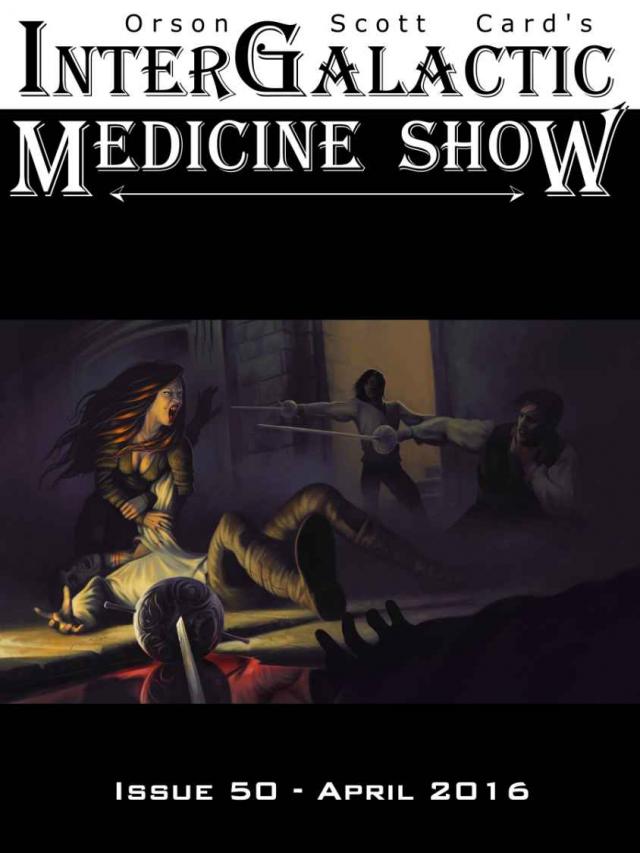
Issue 50 - April 2016
http://www.InterGalacticMedicineShow.com
Copyright © 2016 Hatrack River Enterprises
Table of Contents - Issue 50 - April 2016
* * *
May Our Voices Sing Like Blood from Open Wounds
by Jason Sanford
Cherry Red Rocketship
by James Maxey
Jupiter or Bust
by Brad R. Torgersen
Middle Child Syndrome
by Scott M. Roberts
The Silver of Our Glory, The Orange of Our Rage
by Jared Oliver Adams
Vintage Fiction - Schroedinger's Hummingbird
by Diana Rowland
InterGalactic Interview With Diana Rowland
by Lawrence M. Schoen
Letter From The Editor
by Edmund R. Schubert
May Our Voices Sing Like Blood from Open Wounds
by Jason Sanford
Artwork by Dean Spencer
* * *
The barber whispers "ad Dei gloriam" as he gelds me, his tongs a red-hot star blazing the firmament of my opium dream. Siface swore the opium would dull my pain, but when the falling star reaches my flesh I still taste the cut and burn.
My scream is a beautiful, painful song. Or it becomes one in my opium dream.
Siface holds my hand and joins my song as flesh leaves flesh, his mezzo-soprano voice the purest of angels delighting in what he hopes I'll one day accomplish.
"You are now like me," he says in his high-loving voice. "I will teach you. I will mold you."
Ad Dei gloriam. To the glory of God.
Five years later God forsakes us on a dark road between Bologna and Ferrara. Instead of screaming, Siface sighs a perfect note as he dies on the packed dirt and stones. His sigh sounds like a new song he created far too late for anyone in this world to enjoy.
As the vampire finishes drinking Siface's blood, the monster eyes me, no doubt wondering why I didn't flee.
"I've no need to kill you, little boy," she says. "You didn't play games with my master's mistress. Or did you?"
I shake my head and stare in fascination at Siface's dead body, which looks nothing like the endlessly ritualized killings my master enacted in opera houses across Italy. I still remember the first time I saw him perform as King Siface, singing his love for Sofonisba and how he'd save both of them from the Romans. After that I--and most of his admirers--had been unable to call him anything other than Siface.
"Speak up, boy," the vampire tells me flatly, without emotion. "Was this Giovanni Francesco Grossi? I haven't killed the wrong man, have I?"
"No," I whisper, hoping this monster will let me touch Siface's bloody throat before she kills me. I want to feel the severed vocal cords. I want to know that Siface's performance is truly over.
"No?" the vampire says, mimicking my high-pitched voice. She wipes her mouth clean of a redness which glows faintly in the moonlight. "Ah, you are castrato, like this one. I have long appreciated the musical voices of your kind."
I ignore the vampire, trying to keep my fear in check as I step to Siface's body. In the distance a rooster crows. Down the road a candle shivers in a farmhouse window. Tiny bubbles dance and pop from Siface's ripped throat as the blood the vampire didn't swallow dribbles across the road's stones and packed dirt.
I reach into Siface's throat and touch his vocal cords. They are still warm. I push my fingers against them, wondering if I can make them again sing the voice which entranced all of Italy.
The vampire squats beside me, puzzled by my behavior.
"Who made you?" I ask.
"My master. Or more accurately, one of my master's predecessors. Who made you?"
I point at what remains of Siface's voice. I remember Siface giving me the opium and taking me in a daze to the barber. I remember the blazing star of the red-hot tongs before they cut my flesh.
"Ad Dei gloriam," I mutter.
"I see," the vampire says. "Well, little boy, you present me with a problem. Siface played at an affair with my master's mistress and I was sent to kill him. But I received no instructions on what to do with you. And here you are."
"Here I am."
The vampire grins. But the grin feels forced, as if in mimicry of a real person's smile. "My name is Ferri," she says.
"Nicolo Tenducci. But Siface called me Uccellino."
"Well, after witnessing your master's death you can hardly still be called a baby bird. Care if I call you Uccello?"
I do not care, and when the vampire Ferri walks back to her master's palace, I follow.
I am a capon. I am a rooster crowing about nothing.
Siface said that in our suite of rooms the night before he died. We were in Bologna for a new opera dedicated to Giovanni Battista, the city's cardinal legato and de facto ruler. The cardinal told us of his excitement at having the famous singer perform in his city. Siface behaved graciously to the Cardinal's face while secretly telling me--in the perfect arrogance of his high-pitched voice--how he'd play the noble fool for all he was worth. I'd already seen the cardinal's mistress hanging around Siface, and I hoped my master's arrogance wouldn't lead him to risk both our lives on a role he lacked any desire to consummate.
But that night--the day before Siface's final performance, before we fled the cardinal's palace, before the vampire killed Siface--Siface was anything but arrogant. I found him sitting in the dark on his bed, staring out the window at the town below.
"Ah, Uccellino," he said in his high voice. "Come here, little bird, and tell me what Cardinal Battista says of my performance."
"According to the servants, Cardinal Battista invited all of his friends in the nobility and clergy, and even a few of his enemies, to witness your opera."
"That's not the performance I meant," Siface said, smiling mischievously. "I suppose the cardinal has not learned of my true performance in his house." He laughed and fell backward in dramatic fashion across the bed. The other opera house singers and apprentices often laughed at Siface's bad acting, with one singer comparing Siface's performances to a dog in heat yelping for a mate. And they were correct--Siface was a poor actor. But people didn't come for his acting. They came for his singing.
But as Siface laughed at his little joke, I was horrified. "What have you done?" I asked, knowing that if Siface had done something to make the cardinal angry I'd also be at risk. "Do we need to flee tonight?"
"No. We'll flee after tomorrow's performance. I won't disappoint my public."
As Siface lay there, he looked at my anxious face and laughed. "Don't worry, Uccellino" he said. "Even the cardinal wouldn't harm a young boy like yourself."
I wasn't so sure. The cardinal had recently ordered a boy of 15 whipped to death for stealing from the church, and that boy was the same age as me. And depending on what Siface meant by the other "performance" he'd undertaken . . .
"Do you ever regret becoming one of us?" Siface asked.
"No, master. I am what I have become. And I enjoy the singing."
I thought Siface was merely speaking randomly as he often did. But then I noticed his eyes slicing into my own and his thin face tensing.
Unlike most castrati, Siface's body had never given way to extra flesh. He was as lean as when he'd first been cut decades before as a young boy. He was also strong, and given to beating me when I didn't give him the appropriate answer. Or when my singing practices went poorly. Which was often, as my voice had never developed as he'd desired.
As he stared at me I realized he wanted an honest response.
"I do like the singing," I admitted. "And having regular meals. And staying in the nobles' homes. But I wonder sometimes what I'd have become if I hadn't been cut."
"You'd have been poor. And hungry. That's why your family gave you to me."
Anger flowed around Siface's dark eyes and I prepared myself for a beating. Then he grinned. "I too have wondered what my own life would have been," he said. "Perhaps we both would have been better off. A castrati's life is nothing without his performance. We're only accepted as long as we're singing in an opera house or the Sistine Chapel or some dirt-poor cathedral in the countryside. Leave those performances behind and we're hated."
I didn't need Siface to tell me that. Only two days ago I'd been beaten up by several of the servants' children. They'd said I was neither a boy nor girl and didn't deserve to sleep in the cardinal's holy palace. I'd experienced similar treatment from others since Siface gelded me. And from what older castrati told me, the treatment would become worse as I grew older.
There was a knock at the door of our rooms and the handmaiden of the cardinal's mistress stepped inside. "My mistress needs speak with you," the handmaiden said. "An issue with your . . . performance . . . has come up."
Siface nodded. After I helped Siface wash his face and pull on a clean shirt, he hugged me close. "I am a capon," he whispered. "I am a rooster crowing about nothing even as the performance rolls ever on. Never forget. Without a performance, the world wouldn't allow people like us to even dream of existing."
The vampire Ferri sneaks me into the cardinal's palace through a tunnel hidden between perfectly trim gardens and a statue-filled fountain. The morning sun is near to bursting above the horizon, and when we finally enter the tunnel's depths, Ferri chuckles.
"You almost kept me out too long," the vampire says, glancing back at the approaching sunlight. "That would have been the perfect lesson about how sentimentality endangers even the worst of us."
As I follow Ferri down the tunnel I remember the servants' children who beat me bloody a few days ago. They'd been pretending to hunt vampires, with the boys carrying stakes and the girls shrieking about a vampire hidden in the palace. I'd asked to join their game, only to be beaten for daring to speak to them in my impossibly sing-song voice.
I now wonder if the children's game was their way of dealing with a truth they couldn't speak to others, let alone to a castrato.
The tunnel ends at a ladder and Ferri climbs up, opening a trapdoor into a dark, cool room. She lights a candle. The walls are thick stone blocks and the ceiling multiple arches of equally thick stone. The weight of the entire palace seems to squat upon my chest, making it nearly impossible to breathe, let alone sing.
Along one of the walls rests a wooden coffin laid across the stone floor. A heavy wooden door is embedded in the stone on the opposite side of the room, a massive crossbar blocking anyone outside the room from entering.
Ferri gestures toward her coffin. "You're welcome to sleep in my bed if you wish," she says. "If not, I will bring you bedding and you can make a place on the floor."
I glance at the barred door. "You don't want visitors, do you?"
"I really don't."
"Then why not simply kill me?"
Ferri grins her fake grin, her pale face reminding me of Siface. Ferri is thinner than Siface, and taller, with long fingers on what Siface would have called large painter's hands. Her voice is a little deeper than his, but I've no doubt she could imitate the sarcastic high-pitch laughs Siface gave noblemen and ladies when they asked why he'd become a castrato in the first place.
"I live for the performance," he'd tell the nobles. "There's no better way to honor God for making us what we are."
I want to tell Ferri this memory, but I notice she still hasn't said why she's yet to kill me. Instead of answering, she unbars the door and opens it.
"Wait here," she says. "I must report to my master."
"Will you tell the cardinal about me?" I ask, guessing her master and the cardinal are one and the same.
Ferri nods. "I doubt he'll order me to kill you since Siface was my target. But I could be wrong." She points toward the trapdoor. "You may still flee if you desire."
I remember what Siface told me--that there was no place for castrati in this world unless we're performing. I have nowhere to go. I remember the times I'd met the cardinal over the last few weeks. Better to take a chance on the cardinal allowing me to stay than begging from unknown townsfolk and villagers who may kill me as well as help.
Without waiting for my response, Ferri closes the door, leaving me alone in the belly of the palace.
The cardinal allows me to live in his palace, provided I stay in Ferri's room. "Cardinal Battista is as godly a master as I've had," Ferri says. "He'll make inquiries and see if any choirs desire a new castrato apprentice. But it'd be best if you aren't seen by the cardinal or his servants. The cardinal is … uneasy with how castrati are created."
I understand. I make many people uneasy.
Still, at least I have somewhere to stay. Ferri brings me food and watered wine from the cardinal's dinner table and bedding from his servants' quarters. Since I can't wander through the rest of the palace, I sleep during the day like Ferri does. When Ferri leaves through the trapdoor at night, I'm free to go outside. I suspect she wants me to simply run away while she is gone so she won't have to concern herself with my welfare.
But each time she returns I'm waiting for her in the little room.
To pass the time I practice my singing lessons. I imagine Siface standing behind me with his rod, striking my back for each wrong note and missed breath. I'm so far under the palace no one can hear me.
One night Ferri returns while I'm singing. She's so silent I don't hear her as I practice my trills. When I finally stop, she stares at me in disbelief.
"Was I that bad?" I ask.
"No, not bad . . . not exactly. But something is missing. Something I've heard in the singing of Giovanni Grossi and the other castrati."
I kick my bedding in anger. "That's what Siface used to tell me. My voice didn't develop as he'd hoped. He said I should never have been gelded and instead have stayed poor and died in some passing plague."
"Then why keep singing?"
"Because there's nowhere else for me to go. If you're castrato, you either perform or die. If I improve a little I might join the choir of some minor church or cathedral. At least then I'd be able to eat and live."
I remember Siface's stories of castrati who'd tried to return to their old lives. How they'd been murdered or simply disappeared. Even the church which supposedly loved our singing wouldn't protect us if we weren't performing. Too many people hated those who blurred the supposedly God-given separation of man and woman.
"That's why Siface kept you on," Ferri says. "Even when he realized your voice would never reach his expectations."
I nod. "I hated him, but he kept me alive."
Ferri sighs, and glances around the candle-lit room. "No more singing," she announces. "I mislike performances. Or at least performances without meaning. From now on you'll come with me in the evenings."
Ferri takes me each night into the streets of Bologna. Before, when I'd been with Siface, I'd barely seen the city as we travelled by carriage to Cardinal Battista's palace or the opera house. But Ferri shows me everything I've missed, from the Due Torri to the night markets to the grand city gates like the Porta Saragozza and the Porta Maggiore.
Ferri also talks about the history of Bologna. How before the city came under the sway of the Papal States the House of Bentivoglio ruled. During that long-ago time the arts flourished and women were freer than in any other city in Italy. Some even earned degrees from the university.
This last point seems like a strange thing to mention, and I ask Ferri if she'd been alive then. After all, I've heard vampires live for many centuries. But as with all things about her life, Ferri refuses to answer.
We do more than wander the city. Once or twice a week Ferri calls at a house or mansion or poor worker's hovel. During these times I stand silent--Ferri doesn't want my voice drawing speculation as to who I might be--and listen as she talks.
The conversations always go the same way. Ferri inquires about the health of the person we are visiting, and their family's health. She then discusses Cardinal Battista's expectations. Usually that's all it takes.
Only once does she say the cardinal is disappointed with someone. She says this to a squat little baker who has been agitating for the city's Senate to be responsible to the people instead of the cardinal. Because the baker is a pious man who tithes and is known for giving leftover bread to the poor, Ferri simply requests he show more discretion in his politics.
But when that suggestion doesn't stop the baker, Ferri and I return a second time to his bakery. Ferri sits down at a flour-coated table across from the baker while the man's children and wife watch from the front of their store. When Ferri says that I'd appreciate a slice of fresh filone, the baker's youngest daughter hurries over with the bread.
Her face is white from flour. Or fear. I'm unable to tell which.
"I like you," Ferri tells the baker. "The cardinal likes you. But you must stop involving yourself in matters which need not concern you."
"But signorina, this city has a long history. The people merely want to control a little of their destiny. Surely you know what this city could be if the cardinal would only grant us a taste of freedom."
Ferri smiles her fake smile, revealing her long canines. "I know our history. But history doesn't change the fact that Cardinal Battista is very disappointed in you. Surely you know enough about me to not want to disappoint the cardinal."
I don't need to guess what results from such disappointment, and neither does the baker.
"This is not just," the baker yells. "This is not holy. For the cardinal to allow such acts . . ."
Ferri bows her head slightly as if praying and repeats a Bible verse she once quoted to me when I asked how she'd become a vampire. "There are those whose teeth are swords, and whose jaws are set with knives to devour the poor from the earth and the needy from among mankind." Ferri raises her head back up and stares at the baker's throat. "Should I go on?"






